Mission Samurai II Review
My Mission Samurai II test: analysis & comparison
CompetitionMy analysis
My opinion on the Mission Samurai II
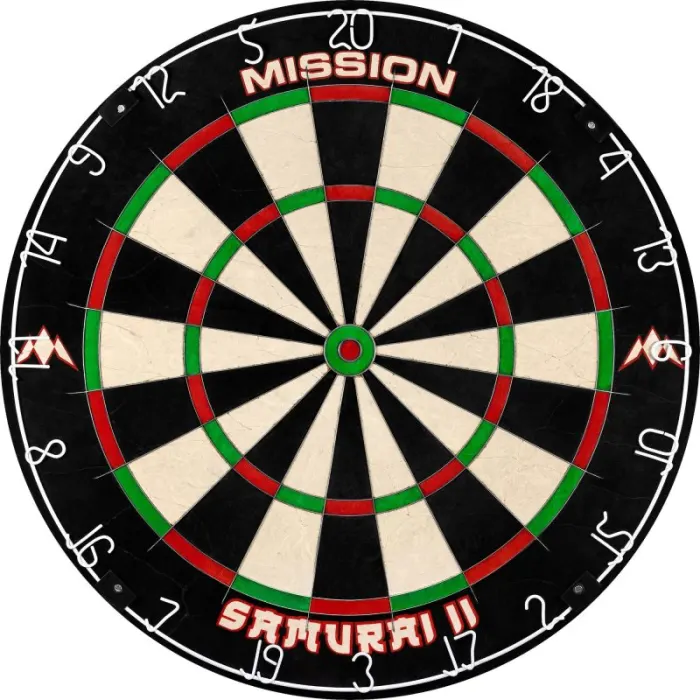
The Mission Samurai II holds a unique place in the Samurai range: it's the go-to competition dartboard, and more importantly, the only model in the series explicitly WDF-approved, used as the official board by federations such as the UKDA and the SDA. On paper, it doesn't post the most spectacular scores in the Mission catalogue, but it has one advantage no other Samurai can claim: certification.
With an overall rating of 7.2/10, this isn't the most impressive board I've tested, but it's honest about what it offers. Good-quality African sisal, a staple-free blade spider, tidy but unremarkable finishing: this is a solid, coherent profile, built to last in club and competition play rather than to impress on a spec sheet.
My test of the Mission Samurai II on the oche
The first thing that stands out when throwing is the behaviour of the ultra-thin, staple-free blade spider. The absence of staples clearly reduces the classic bounce-out points, and darts that clip a wire tend to slide rather than ricochet sharply off the board. The 8/10 bounce-out score reflects this feel accurately at the oche.
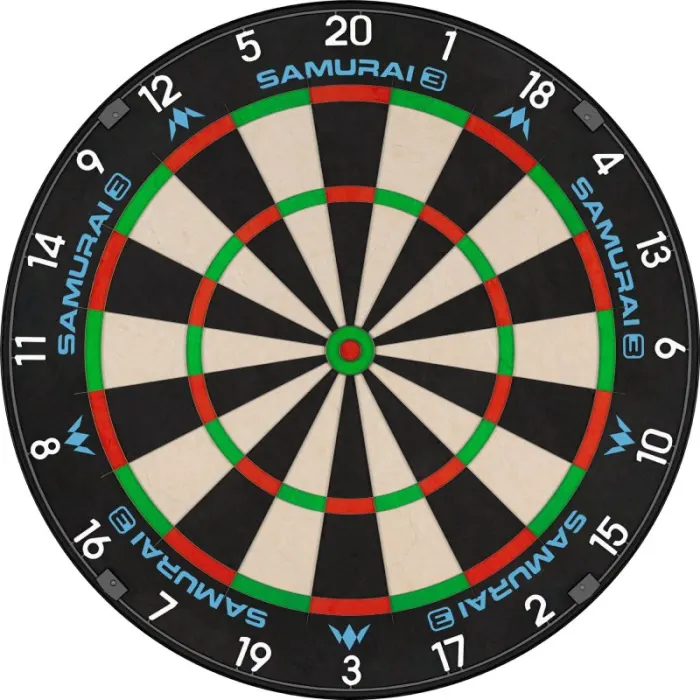
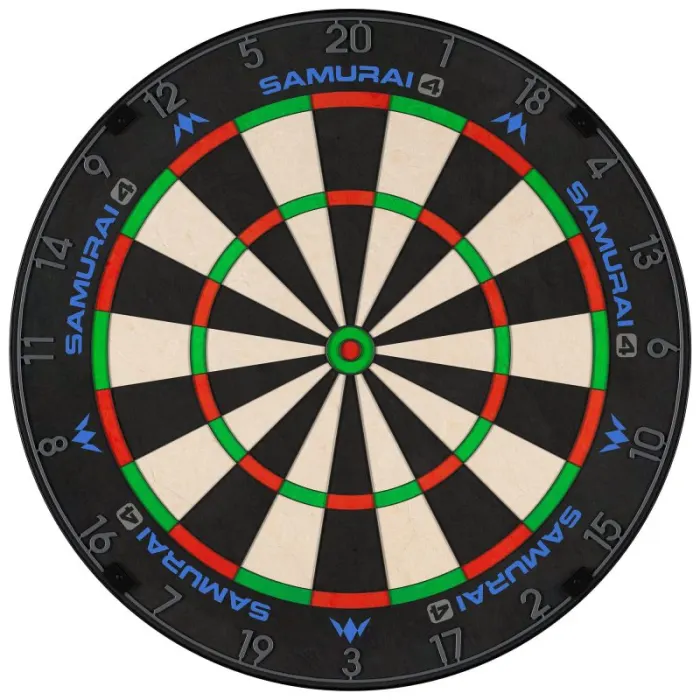
Visual comfort, at 7/10, stays average: the segments are legible without being as sharp or high-contrast as on newer models in the range like the Samurai 3 or Samurai 4. Nothing bothersome in normal use, but it's clear this isn't the model's priority, which focuses first and foremost on regulatory compliance and durability for competitive play.
Durability of the Mission Samurai II
With a score of 7/10, the Samurai II's durability sits in the upper-average range for this price segment. The African sisal used holds up well under repeated sessions, and the staple-free construction indirectly contributes to longevity: fewer staples means fewer localised weak points on the spider wire over time.
This isn't a premium board built for years of intensive daily use without rotation, but for a club player or competitor using it regularly and reasonably, it holds up well. The perceived quality score, also at 7/10, confirms this impression: the product feels reliable and serious, without aiming for the high end of the market.
Setting up and mounting the board
Setting up the Mission Samurai II doesn't present any notable quirks compared to market standards. As with any board of this format, it's best to plan for a sturdy wall mount and check the centre alignment against the regulation height (1.73 m) and throw distance (2.37 m for steel tip).
Since precise diameter and segment width figures aren't communicated for this model, I recommend checking the official Mission spec sheet before purchase if those measurements matter for your setup, especially if you're installing it alongside other certified boards to keep consistency in play.
Price and value for money
The Mission Samurai II is generally priced between €35 and €48 depending on the retailer (estimate, to be adjusted depending on the retailer and promotional periods). At that price, it's a very good compromise: you get a reliable, durable board with an effective anti-bounce spider, and above all a certification that carries real value for anyone wanting to play in official competitions.
Value for money is clearly one of the model's strong points. It doesn't try to compete with premium boards on visual comfort or ultra-refined finishing, but it delivers the essentials seriously, at an accessible price for a club player who wants to train on a board that meets competition standards.
Verdict: should you buy the Mission Samurai II?
The paradox of the Samurai range is that the newer, better-rated models, the Samurai 3 and Samurai 4, are not certified for official competition. If your goal is to train or play on a board strictly identical to those used in WDF, UKDA, or SDA tournaments, the Samurai II remains the only logical choice in the range, despite more modest individual scores.
For a serious club player or a competitor wanting to progress under realistic conditions, this is a rational, relevant purchase. On the other hand, if certification isn't a criterion for you and you're primarily after the best visual comfort or finishing in the Mission catalogue, the newer models in the range will better meet that expectation.
Criteria breakdown
Durability
At 7/10, the Samurai II's durability sits in the upper-average range for its segment. The African sisal handles repeated sessions well, and the staple-free construction limits localised weak points on the spider wire over time. It's not a premium board built for years of intensive use without rotation, but it comfortably holds up for a club player or a regular competitor.
Bounce-out
The ultra-thin, staple-free steel blade spider noticeably reduces bounce-outs at the oche: darts that clip a wire tend to slide rather than ricochet sharply off the board, which justifies the 8/10 score. It doesn't quite reach the level of the ultra-thin razor spiders found on premium models, but it remains very effective for this price segment.
Finish
Finishing, at 7/10, is tidy without being exceptional: there's nothing to criticise about the cleanliness of the assembly, but it's far from the level of detail found on premium boards in the range. A logical trade-off for a model designed first and foremost for competition compliance rather than aesthetics.
Visual clarity
Visual comfort scores 7/10: the segments remain legible during play, without matching the contrast and sharpness of newer models like the Samurai 3 or Samurai 4. Sufficient for regular use, but clearly not this board's main selling point.
Pros & Cons
Pros
- The only board in the Samurai range that is WDF-certified, officially used by the UKDA and the SDA
- Ultra-thin, staple-free blade spider that is very effective against bounce-outs (8/10)
- Good-quality African sisal that holds up well under repeated sessions
- Very good value for money for club and competition use
- A rational, consistent choice for anyone wanting to train under real tournament conditions
Cons
- Visual comfort and finishing are average, falling behind newer models like the Samurai 3 and Samurai 4
- Diameter, segment width, and weight are not disclosed by the manufacturer, making precise comparisons with other boards harder
Frequently asked questions about the Mission Samurai II
Yes. It's the only model in the entire Samurai range explicitly WDF-approved, and it's used as the official board by federations such as the UKDA and the SDA. This is the model's central selling point.
The Samurai 3 and 4 are newer and generally rate higher on certain criteria, but they are not certified for official competition. The Samurai II therefore remains the only choice in the range for anyone wanting to play or train on a board that meets tournament standards.
It's aimed primarily at serious club players and competitors who want to train under conditions identical to certified tournaments, rather than casual players looking for the best visual comfort or the most refined finishing.
Installation follows the usual standards: a sturdy wall mount, board centre at 1.73 m from the floor, and a throw distance of 2.37 m for steel tip. Since the manufacturer doesn't specify diameter or segment width for this model, it's worth checking the official spec sheet if those measurements matter for your setup.
Expect generally between €35 and €48 depending on the retailer and promotional periods (estimate, to be adjusted). At that price, it offers excellent value for money given its competition certification.
Player reviews Mission Samurai II
Write a review
Sign in to leave a review for this product.
Sign inNo reviews yet
Be the first to review this product!